

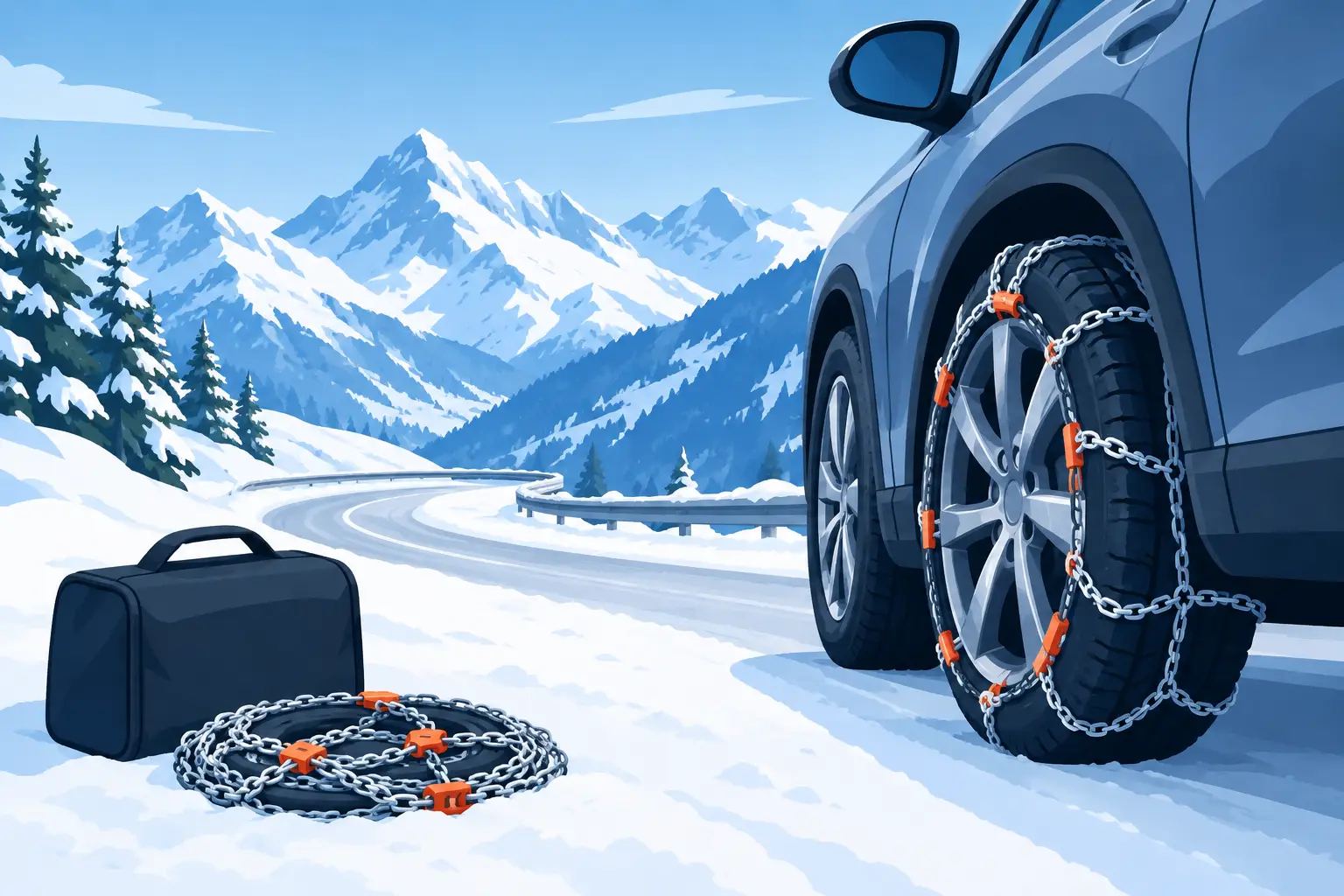
A winter road journey into the French Alps can require snow chains even when your vehicle has winter tires. This guide to French Alps snow chains explains what changes at the roadside, what your driver should carry, and when a winter-ready 4x4 is the more comfortable choice. For guests arranging a same-driver journey from Paris to Saint-Tropez, published private chauffeur service begins from €1,600, while Alpine journeys are quoted around the precise route, vehicle, luggage, and weather requirements.
The key point is simple: do not treat chains as an optional ski-trip accessory. On roads serving Courchevel 1850, Courchevel Moriond 1650, Courchevel 1550, Le Praz, Méribel, and Val Thorens, weather can change quickly after the valley floor. Your transport plan should account for the law, the road signs, and the final uphill approach to your chalet or hotel.
What French Winter Equipment Rules Mean
France's winter-equipment rules apply in designated mountain municipalities from November 1 through March 31. In these zones, vehicles must either be fitted with approved winter tires on all four wheels or carry removable traction equipment, such as chains or snow socks, for at least two drive wheels. The relevant entry signs identify the areas where these requirements apply.
For travelers, the practical distinction matters. Proper winter tires are designed for cold conditions and regular snowy-road use. Chains provide extra grip when snow is compacted, steep roads are untreated, or a chain requirement is posted. A vehicle equipped with winter tires may still need chains when a road sign specifically requires them.
The law is not a promise that every mountain road will be easy. A heavy snowfall, a steep final access road, or a temporary closure can change the sensible route. Your chauffeur should monitor conditions and choose safety over a rushed arrival.
French Alps Snow Chains: When They Are Required
The sign that matters most in active snowfall is the blue circular chain sign. It indicates that chains must be fitted to at least two driving wheels. In this situation, carrying chains in the trunk is not enough. They need to be installed before entering the signed section.
This is why experienced mountain drivers fit chains at a safe, level pull-off rather than waiting until the vehicle loses traction. The operation takes time, requires space around the wheels, and is unpleasant in wind or falling snow. It is far more efficient to prepare before the steepest section of road.
Snow socks can be permitted as removable traction equipment in the broader winter-equipment zones, but they are not interchangeable with chains in every real-world situation. They wear faster, are less suited to prolonged use on exposed pavement, and may not be accepted where the road condition or posted instruction calls for chains. For a high-altitude arrival during a snowstorm, metal chains remain the more dependable option.
The Vehicle Must Be Chain-Compatible
Not every wheel and tire combination has adequate clearance for conventional chains. Some vehicles require low-clearance chains, while others have manufacturer restrictions that make snow socks or an alternative approved system necessary. This is not something to guess at after landing at Geneva Airport or Chambéry Airport.
A professional operator confirms the vehicle's approved equipment in advance. For a family traveling with ski bags, several large suitcases, and child seats, that planning also determines whether a winter-ready 4x4, VIP van, or a separate luggage solution is the appropriate choice.
Choosing the Right Equipment for Your Stay
For guests driving themselves, buy or rent chains that match the exact tire size shown on the sidewall. Practice fitting them once in dry conditions. Keep gloves, a kneeling mat, a flashlight, and warm layers accessible rather than packed beneath luggage. After use, remove chains as soon as the road is clear to avoid damaging both the equipment and the road surface.
For visitors who prefer not to manage this at the roadside, the value of a private winter chauffeur is operational rather than decorative. The vehicle is selected for the route, traction equipment is checked before departure, and the driver understands when conditions call for a slower approach or a different access point.
As A.S, founder of Prestigo Chauffeur, puts it: “In the mountains, a refined journey is one where the guests never have to think about the road conditions.”
This does not mean weather disappears as a factor. It means it is handled with calm preparation: a confirmed pickup, a suitable vehicle, room for ski equipment, cold water and music in the cabin, and clear communication if conditions affect the final approach.
Why a Chauffeur Can Be Easier Than a Taxi or Uber
A taxi or Uber can be useful for short urban journeys, but winter mountain logistics are different. Metered fares, surge pricing, and uncertain vehicle availability create unnecessary variables when roads are affected by snowfall. They also do not guarantee a particular vehicle configuration or winter equipment.
A pre-booked chauffeur service works on a fixed price, with the vehicle confirmed for the party and luggage. Flight tracking supports airport arrivals, and a guaranteed winter-ready vehicle can be planned rather than requested at the curb. This matters especially for late arrivals, families, and guests checking into a chalet in Courchevel 1850 after dark.
It also helps to distinguish between a road that is legally open and a journey that is genuinely comfortable. A capable vehicle and an experienced driver provide confidence, but they do not override closures, chain controls, or instructions from local authorities. Flexibility remains part of responsible Alpine travel.
A Practical Plan for a Snowy Arrival
Before departure, share your hotel or chalet address rather than only the resort name. Les Trois Vallées covers a large area, and the final approach to a property can be materially different from the route into the village. Tell your transport team about skis, snowboards, oversized bags, and children so the vehicle is assigned correctly.
Build a little margin into your schedule on a snowfall day. Avoid planning a tightly timed dinner immediately after arrival, particularly if you are heading higher in the resort. If the weather is clear, the extra preparation may never be visible. If it deteriorates, it is what keeps the journey composed.
For self-drivers, inspect the rental vehicle before leaving the airport. Confirm the tire marking, ask where the chains are stored, and ensure the chain size matches the fitted tires. A generic assurance that the car is “equipped for winter” is less useful than knowing exactly what is on board.
FAQs About French Alps Snow Chains
How much does a long-distance private chauffeur journey cost?
Prestigo's Paris to Saint-Tropez same-driver service starts from €1,600 in a sedan, with a fixed price and planned door-to-door service. A taxi may run on a meter and Uber pricing can surge or depend on availability. Alpine travel is priced according to the actual journey, vehicle, passenger count, luggage, and winter conditions.
Are snow chains mandatory in the French Alps?
They can be. In designated mountain zones between November 1 and March 31, vehicles need approved winter tires on all four wheels or removable traction equipment for at least two drive wheels. A posted chain sign can require chains to be fitted.
Are winter tires enough for Courchevel?
Often, winter tires are the correct foundation for winter driving, but they do not remove the need to carry chains where required. During heavy snow or on signed stretches, chains may still be necessary.
Can I use snow socks instead of chains?
Snow socks may meet the broader removable-equipment requirement in relevant zones, but they are not always the best choice for demanding conditions. Follow posted instructions and your vehicle manufacturer's guidance; chains offer stronger traction for difficult, snow-covered climbs.
Which wheels need snow chains?
Chains are normally fitted to the drive wheels. The correct axle depends on whether the vehicle is front-wheel drive, rear-wheel drive, or four-wheel drive. Consult the vehicle handbook and the chain manufacturer's instructions before travel.
Can a chauffeur fit snow chains during the journey?
A winter-trained chauffeur can manage the equipment carried for the vehicle and conditions, fitting it safely when needed. This is one reason to arrange suitable transport in advance rather than rely on an on-demand vehicle during snowfall.
Should I book a 4x4 for a ski holiday?
It depends on your destination, luggage, party size, and the forecast. A 4x4 offers useful capability for mountain roads, yet tire quality, appropriate chains, driver experience, and local restrictions remain just as significant.
What should I tell my chauffeur before a French Alps trip?
Provide flight details, the exact accommodation address, passenger count, child-seat requirements, and a realistic description of ski and luggage volume. For a chalet above the main village, mention any narrow or steep access road so the arrival can be planned properly.
The best Alpine arrival is not defined by how quickly the road is covered. It is the one that reaches your door with the right equipment, a clear plan, and no need for anyone in the cabin to step into the snow.
Plan your transfer with Prestigo Chauffeur Saint-Tropez · view our transfer rates or book an hourly chauffeur.