


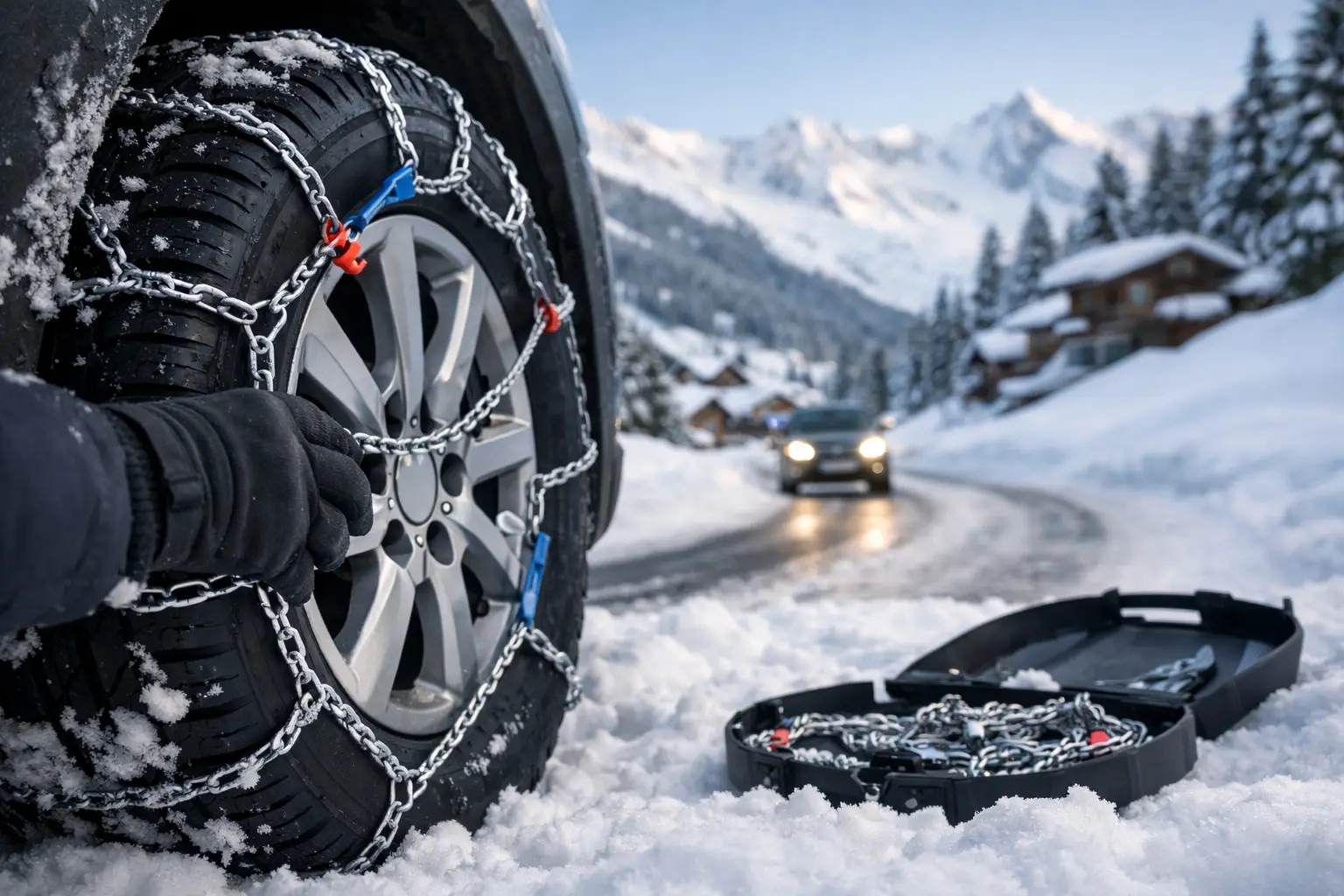
A vehicle traveling to Courchevel between November 1 and March 31 must meet France’s winter-equipment rules for designated mountain areas. Courchevel snow chain requirements are straightforward on paper, but the right preparation matters when snow is falling above Moûtiers. Private winter transport can be arranged from €420, with a properly equipped vehicle, luggage space, and a chauffeur who plans around the day’s conditions rather than leaving details to chance.
What France Requires for Courchevel in Winter
Courchevel is within Savoie, one of the French departments covered by the mountain-law winter equipment regulations. During the annual winter period, passenger vehicles must either be fitted with four approved winter tires or carry snow chains or snow socks suitable for at least two drive wheels.
For winter tires, look for the 3PMSF marking - the three-peak mountain snowflake symbol. This is the recognized standard for the regulation. Older M+S-only tires are not the same thing, so travelers collecting a rental car should check the tire sidewall rather than relying on a general “winter-ready” label.
Chains or textile snow socks must match the vehicle’s tire size and be accessible inside the car. A boxed set at the bottom of a fully packed trunk is technically present, but it is not especially useful when conditions change on the climb.
These rules apply regardless of whether a vehicle is front-wheel drive, rear-wheel drive, all-wheel drive, or a 4x4. Four-wheel drive improves traction, but it does not replace the legal equipment requirement or careful driving on a steep, icy road.
When Chains Need to Be Fitted
Carrying chains is different from fitting them. The road to Courchevel can remain clear after a cold night, then become snow-covered during an active weather front or following a rapid temperature drop. Road signs and instructions from local authorities take priority, and some sections may require chains to be installed when conditions demand them.
The final approach to Courchevel 1850 is more exposed to snow and traffic than the lower valley. Courchevel Moriond 1650, Courchevel 1550, and Le Praz sit at different elevations, yet all can be affected by the same storm system. A clear departure from Geneva, Chambéry, or Lyon does not guarantee a clear arrival in Les Trois Vallées.
Metal chains offer the strongest grip in deeper snow and on compacted ice. They are also slower to fit and require a dry run before departure. Snow socks are lighter, easier to store, and accepted under the winter-equipment rule, but they can wear quickly on bare pavement. They are best treated as a practical contingency, not an excuse to continue driving after the road has cleared.
“A mountain transfer is won before the vehicle leaves,” says A.S, founder of Prestigo Chauffeur. “The right tires, the right equipment, sufficient time, and calm communication make a real difference for guests arriving with children, ski bags, or a chalet check-in.”
Rental Cars: Check Before You Leave the Airport
A rental agreement does not confirm that a vehicle meets Courchevel’s winter requirements. Before leaving Geneva Airport, Chambéry Airport, or Lyon-Saint-Exupéry Airport, confirm whether the car has four 3PMSF tires or whether chains or snow socks are supplied. Ask where they are stored, whether they fit the exact tire size, and whether the rental company permits their use.
This matters particularly for premium sedans with low-profile tires. Some models have limited wheel clearance and may require a specific chain design. Fitting an unsuitable set can damage the vehicle, brakes, or suspension. If the rental provider gives instructions restricting chains, follow them and ask what approved alternative is available.
It is also sensible to confirm the vehicle’s fuel policy, winter windshield fluid, ice scraper, and roadside-assistance procedure. These details may feel minor in an airport garage, but they become consequential after dark on a busy Saturday changeover day.
Why a Chauffeured Arrival Removes the Guesswork
For guests arriving at Cheval Blanc Courchevel, a private chalet, or the Courchevel Altiport, winter driving is one logistical task among many. Ski equipment, flight delays, children, dining reservations, and luggage can turn a self-drive arrival into an unnecessary interruption to the stay.
A professional chauffeur service assigns a suitable mountain vehicle and prepares it for the route. The vehicle choice should reflect passenger count, luggage volume, ski bags, and the prevailing weather, rather than simply the number of seats. A family of four with ski equipment often needs more capacity than a standard sedan can provide comfortably.
Flight tracking also changes the experience. A chauffeur can adjust the collection time when an inbound flight is delayed, while a taxi meter begins running only once a vehicle is found and a ride starts. With ride-hailing, surge pricing and uncertain availability can be especially frustrating during peak winter arrivals. A fixed-price chauffeur booking offers a guaranteed vehicle, a planned meet-and-greet, and a clear point of contact before the descent or ascent begins.
For exceptional weather, helicopter travel can be coordinated on request between Geneva and Courchevel, with a typical flight time of about 35 minutes. Weather always governs aviation operations, so a fixed-price road option should remain available as a sensible backup. The same level of planning applies at Courchevel Altiport, where ground transport should be ready for the onward chalet or hotel arrival.
Practical Snow Chain Advice for Self-Drivers
If you are driving yourself, practice fitting chains once before the journey. Do it in daylight, on level ground, while wearing the gloves you intend to use. Read the vehicle manual as well as the chain manufacturer’s instructions, because the correct drive axle and maximum speed vary by vehicle.
Keep your equipment together: gloves, a kneeling mat or old towel, a headlamp, and a bag for wet chains make the task cleaner and safer. Do not stop in a traffic lane to fit chains. Use designated fitting areas where available, keep clear of moving vehicles, and allow the engine and brakes to cool if the climb has been demanding.
Once chains are fitted, drive gently and avoid sudden steering, acceleration, or braking. Remove them when you return to bare road surface. Leaving chains on dry pavement rapidly damages both the chains and the road.
Courchevel Snow Chain Requirements: A Simple Decision
The practical choice depends on your itinerary. Travelers making a short daytime journey in a fully equipped rental vehicle may be comfortable driving themselves. Those landing late, traveling with a family, or arriving during a Saturday peak may prefer the assurance of a chauffeured 4x4 prepared for the mountain road.
Either way, do not assume that an SUV badge, all-wheel drive, or a promise of “snow capability” is enough. Confirm the 3PMSF tires or the correctly sized chains before setting out, watch local weather and road guidance, and leave more time than a summer map estimate suggests.
Frequently Asked Questions
How much does a chauffeured Courchevel winter journey cost?
Private winter transport is available from €420, depending on the collection point, vehicle category, timing, and passenger requirements. Unlike a taxi meter, a fixed-price booking is agreed in advance. It also avoids ride-hailing surge pricing and the uncertainty of finding a suitable vehicle during heavy snowfall or peak arrivals.
Are snow chains mandatory in Courchevel?
From November 1 through March 31, vehicles in the designated mountain area must have four 3PMSF winter tires or carry chains or snow socks for at least two drive wheels. Separate road signs or local instructions may require chains to be fitted when conditions deteriorate.
Are snow socks accepted in Courchevel?
Yes. Snow socks are accepted as an alternative under the winter-equipment rule when they are suitable for the vehicle. They are easier to fit than metal chains but are less durable on exposed asphalt.
Do 4x4 vehicles need snow chains?
Yes, a 4x4 is not automatically exempt. It must still comply through approved winter tires or by carrying suitable chains or snow socks. All-wheel drive helps with traction but does not eliminate the need for winter equipment.
What marking should winter tires have?
Look for the 3PMSF symbol, which shows a mountain with a snowflake inside it. This marking confirms the tire meets the required winter standard for the French mountain regulation.
Should I check equipment with my rental company?
Yes. Confirm the tire marking, whether chains or socks are provided, their location in the vehicle, and whether the vehicle has any chain restrictions. This is particularly relevant for luxury sedans and vehicles with low-profile tires.
Can bad weather delay a Courchevel arrival?
Yes. Snowfall, traffic controls, chain-fitting areas, and reduced visibility can extend a journey. A flexible collection plan, flight tracking, and an appropriately equipped vehicle provide more control when conditions change.
Is a private chauffeur useful for ski equipment and families?
Yes. A private chauffeur can match the vehicle to passengers, ski bags, luggage, and child-seat needs, then coordinate a direct arrival at Courchevel 1850, 1650, 1550, or Le Praz. It keeps the first day in the mountains focused on the stay, not on roadside preparation.
A well-planned winter arrival is a quiet luxury: the right vehicle is ready, the route is considered, and your time in Courchevel begins at the door rather than in a chain-fitting bay.
Plan your transfer with Prestigo Chauffeur Saint-Tropez · view our transfer rates or book an hourly chauffeur.