

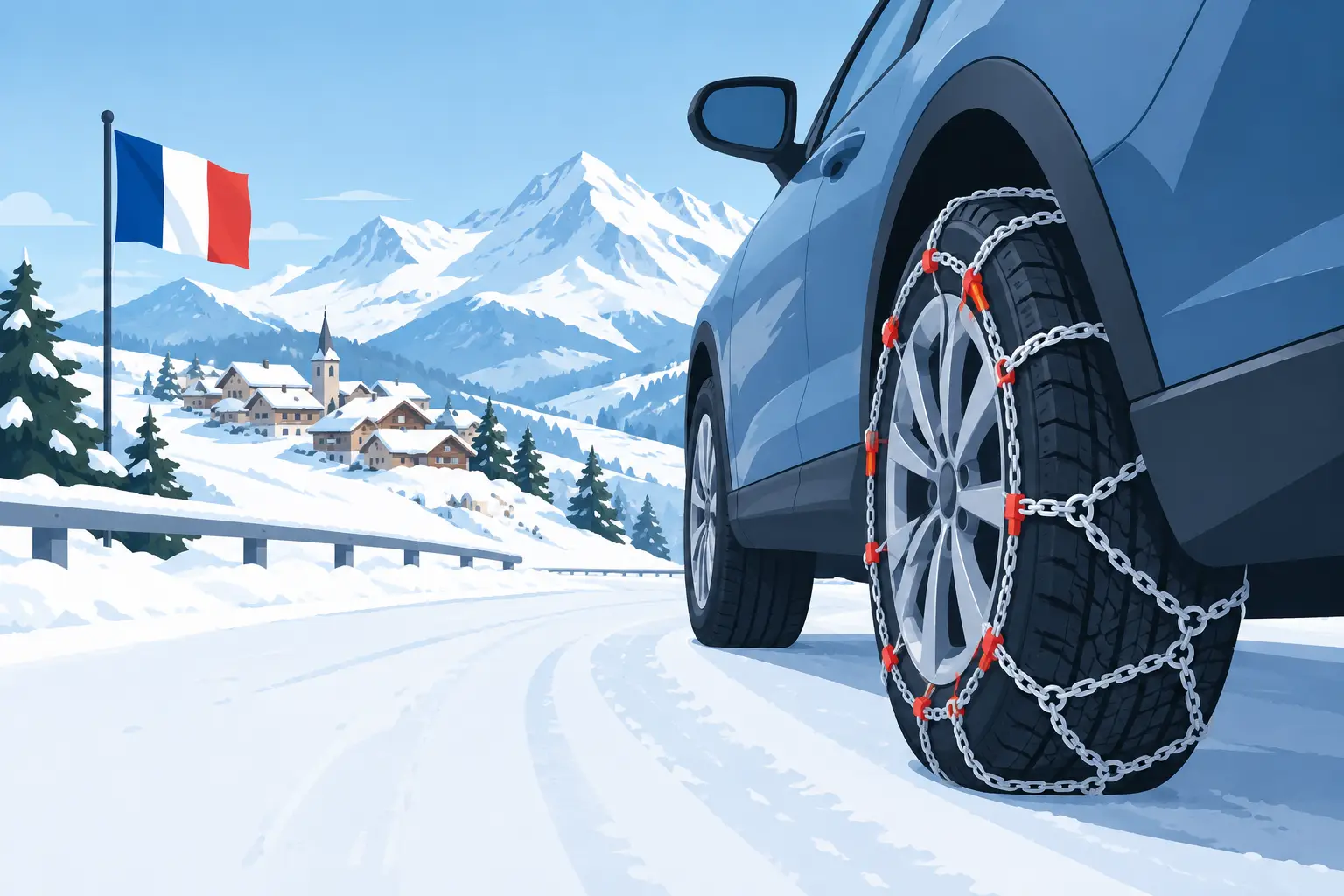
A snowy arrival in the French Alps can turn into a legal and practical issue before you reach the resort. Are snow chains legally required in France? In designated mountain areas, they can be. From November 1 through March 31, drivers must meet France’s winter-equipment rules, whether roads are clear at departure or snow begins later on the climb. For travelers who prefer not to manage the details, a private long-distance journey with Prestigo Chauffeur is available from €1,600 on the Paris-Saint-Tropez route, with a fixed price rather than a taxi meter, surge pricing, or uncertain vehicle availability.
France’s Winter Equipment Rule Explained
France’s Loi Montagne winter-equipment requirement applies in designated mountain municipalities across 48 departments. It is not a nationwide rule for every road in France, and it is not limited to ski-resort access roads. The designated area is set locally, so the obligation can begin well before the final mountain ascent.
Between November 1 and March 31, cars, vans, coaches, and light commercial vehicles traveling through these signed mountain zones must have one of two forms of compliant equipment. They must either be fitted with four approved winter tires, or carry snow chains or snow socks suitable for at least two driven wheels.
For most visitors, the key point is simple: all-season tires marked only M+S are no longer enough for the winter-equipment rule. Since November 2024, compliant winter tires need the Alpine symbol, known as 3PMSF - a mountain with a snowflake inside it. This marking confirms the tire meets the required snow-performance standard.
A vehicle with four 3PMSF winter tires satisfies the general mountain-zone requirement. A vehicle without them must carry chains or approved textile snow socks that fit its driven wheels. Carrying chains is not the same as fitting them whenever conditions demand it, however.
When Road Signs Make Snow Chains Mandatory
France’s winter-equipment law and a road-sign requirement are related but different. The seasonal rule requires suitable equipment in designated mountain zones. A specific roadside sign can require chains to be fitted for the road ahead.
When the blue circular chain sign is displayed, drivers must follow it. Four-wheel drive, an SUV, and winter tires do not automatically exempt a vehicle from an instruction to fit chains. In difficult conditions, local authorities may require chains because of the gradient, compacted snow, ice, or limited room for stranded vehicles to turn around.
This is why a guest heading toward Courchevel 1850, Courchevel Moriond 1650, Courchevel 1550, or Le Praz should not assume that a premium SUV alone solves every winter-road requirement. The final decision sits with the signs and the conditions on the route that day.
> “A winter journey should feel calm from the moment a guest lands. That means the right vehicle, correctly equipped, and a driver who understands mountain conditions rather than treating them as an afterthought.” - A.S, founder of Prestigo Chauffeur
What Happens If You Are Not Equipped
Drivers who fail to comply can face a fine of up to a quote on request. Authorities may also prevent a vehicle from continuing if it is unsuitable for the conditions. The greater risk is often operational rather than financial: being stopped below the resort, delaying a family arrival, or missing a chalet check-in after a long flight.
Rental cars deserve particular attention. Do not rely on the vehicle category alone. Confirm whether the vehicle has four 3PMSF tires, whether chains or snow socks are included, which axle they fit, and whether the rental agreement permits their use. A large sedan with the right tires may be compliant, while a more imposing vehicle on unsuitable tires may not be.
Chains, Snow Socks, and Winter Tires: Which Is Best?
For an extended alpine stay, four 3PMSF winter tires are generally the most convenient answer. They are fitted before the journey and provide more consistent winter performance throughout the trip. They also avoid the need to stop roadside to fit chains when conditions worsen.
Chains provide added traction on steep, snow-covered approaches and remain valuable even for a vehicle equipped with winter tires if a sign requires them. Their trade-off is practical: fitting them in the cold requires space, patience, gloves, and familiarity with the correct procedure. Practice at home rather than attempting it for the first time beside a snowy road.
Textile snow socks are lighter and easier to store. They can be a suitable legal option when approved for the vehicle, but they wear more quickly than metal chains and may have limitations on exposed asphalt. Always check the manufacturer’s instructions and the vehicle manual before buying either solution.
For visitors traveling with children, ski bags, and several suitcases, the simplest choice is often a winter-ready chauffeured 4x4 or van. It preserves luggage space and removes the uncertainty of fitting equipment at the roadside after a flight into Geneva, Chambéry, or Lyon-Saint-Exupéry.
Planning a Winter Arrival Without Guesswork
Check the forecast and road status on the day of travel, but do not wait for snowfall before checking your equipment. The legal obligation follows the calendar and the designated zone, not simply whether snow is visible outside your hotel.
Allow extra time during peak Saturdays and school holidays. The roads into Les Trois Vallées can become slower when traffic builds behind vehicles fitting chains or waiting for a clearance decision. A professional driver will plan for these conditions, select an appropriate vehicle, and adjust the journey around current access restrictions where possible.
This is also where a chauffeured service differs from a taxi or app-based ride. A private booking provides a fixed rate, flight tracking, and a guaranteed vehicle selected for your passenger and luggage requirements. A taxi may operate on a meter, while ride-hailing availability can be limited in mountain areas and pricing may rise sharply in poor weather.
Frequently Asked Questions
How much does a chauffeured long-distance journey cost?
Prestigo Chauffeur’s Paris-Saint-Tropez private journey starts from €1,600 in a sedan, with the same driver door to door over roughly 950 km. Unlike a taxi meter or a ride-hailing fare that can increase with demand, the price is fixed in advance and the vehicle is guaranteed for the booking. Alpine pricing depends on the airport, resort, passenger count, luggage, and required vehicle type.
Are snow chains legally required everywhere in France?
No. The seasonal rule applies in designated mountain municipalities, not across the entire country. However, a chain-required road sign can impose an immediate obligation on a particular road, even outside the broader question of seasonal equipment.
When do the French snow-chain rules apply?
The standard seasonal period runs from November 1 through March 31. Local weather can be mild during part of that period, but the designated-zone rule still applies.
Are all-season M+S tires legal in French mountain zones?
M+S marking by itself is no longer sufficient for the seasonal mountain-equipment rule. To qualify as winter tires, all four tires should carry the 3PMSF Alpine symbol. Otherwise, the vehicle should carry suitable chains or snow socks for at least two driven wheels.
Do four-wheel-drive vehicles need chains in France?
A four-wheel-drive vehicle still needs compliant winter equipment in designated zones. If a road sign specifically requires chains, fit them as instructed. All-wheel drive helps traction, but it does not override local road regulations.
Can I use snow socks instead of metal chains?
Yes, approved snow socks can meet the general seasonal equipment requirement when they are suitable for at least two driven wheels. They are not identical to metal chains in durability or deep-snow performance, so follow their speed and use limits carefully.
What should I ask a rental-car company before driving to Courchevel?
Ask whether all four tires carry the 3PMSF symbol, whether chains or snow socks are included, which wheels they fit, and whether the vehicle has any manufacturer restrictions. Request confirmation in writing if the journey depends on that equipment.
Is a private chauffeur useful for alpine winter travel?
Yes, particularly when arriving with ski equipment, children, or substantial luggage. A winter-ready vehicle, an experienced driver, and a planned route allow you to focus on the chalet arrival rather than tire markings, chain fitting, and changing mountain conditions.
Plan your transfer with Prestigo Chauffeur Saint-Tropez · view our transfer rates or book an hourly chauffeur.